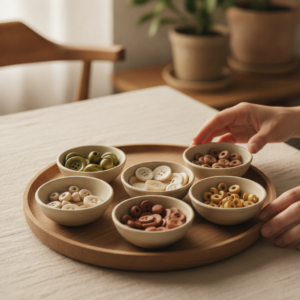
When my oldest turned five, I bought a full kindergarten curriculum box before I’d even watched her play for a week to see what she actually needed. It sat half-used in a closet by October. What she needed that year looked almost nothing like what the box assumed every five-year-old needed.
Ages 5–6 is the stretch where most families start asking “are we doing enough” the loudest, because it’s the year the outside world starts comparing your child to a kindergarten classroom whether you’re in one or not. Here’s what actually mattered for us, across two kids who went through this age completely differently.
Letters and Numbers Matter Less Than Stamina
Both of my 5-6 year olds could recognize letters and count past twenty by this age — that part came easily. What was genuinely hard was sitting still and attending to one task for ten straight minutes. We spent far more time practicing “finish this one thing before moving to the next” than we spent on any actual academic content, and it paid off more.
The Skill Nobody Puts on a Checklist: Losing Well
Board games became our real curriculum for a few months — not for the counting or colors, but because losing a game of Candy Land without a meltdown was a harder, more important milestone at this age than any letter sound. We played on purpose, several times a week, specifically to practice that.
What a Realistic Day Looked Like
- 20–30 minutes of focused table time (letters, numbers, or a workbook page) — never longer, because attention ran out fast.
- An hour or more of unstructured play — this did more for problem-solving than anything we “taught.”
- One read-aloud, every single day, no matter what else got skipped.
- Chores scaled to their size: setting the table, matching socks — these built the follow-through that table time alone never could.
Milestones We Watched — and Ones We Ignored
We paid attention to whether she could follow a two-step instruction, hold a pencil without a full fist grip, and separate from us without distress for a couple of hours. We stopped worrying about reading fluency, handwriting neatness, and whether she could sit through a full 45-minute lesson — none of that is realistic at 5–6, regardless of what a curriculum box implies.
If you’re in this stage right now, our Kindergarten Homeschool: What They Actually Need to Learn This Year goes deeper into the academic side of this same age, and the Ages hub has what comes right before and after this stage.
If you want a simple way to bring more of this into your week, grab our free guide below.