I’ve stood in the kitchen narrating the folding of laundry to a two-year-old, and years later sat across the table trying to answer an eleven-year-old’s question about fairness with no good answer ready. Different kid, different decade, same house. It took three kids to see that both moments were asking me the same underlying question, just at opposite ends of a ten-year stretch.
That question — what does this stage actually need from me right now, not what should already be there — is the whole framework. Here’s the full shape of it, stage by stage.
The Same Three Pillars, at Every Stage
Every stage in the framework gets answered the same three ways: what to actually focus on, what to stop worrying about, and one real thing to try that week. The content changes completely between a two-year-old and a ten-year-old. The shape of the answer never does — which is what makes it a framework instead of seven disconnected milestone charts.
The Seven Stages, Briefly
- Ages 2-3: Presence over curriculum — narrating, repeating, real tools over toy versions.
- Ages 3-4: Protecting long, unstructured pretend play and naming big feelings out loud.
- Ages 4-5: Sorting and pattern play as the real math, letter sounds through games, not drills.
- Ages 5-6: Building stamina for one task at a time over chasing reading fluency early.
- Ages 6-8: Loosening the grip on purpose — stepping back, reviewing after instead of correcting during.
- Ages 8-10: Depth over coverage, and real ownership of a project’s timeline, mistakes included.
- Ages 10-12: Real stakes and real privacy, as practice for independence that’s about to matter more.
Why the Pattern Only Showed Up on the Third Kid
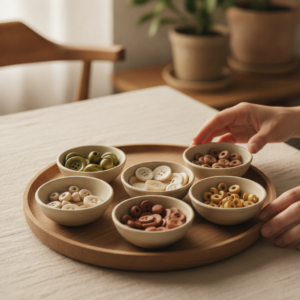
With my oldest, every stage felt like a brand-new problem to solve from nothing. My youngest spent a full week at four sorting every button and bottle cap in the house by color, completely unprompted — a different fixation than her older siblings had, but the same underlying drive to categorize and master something small and repeatable. The specific interest always changes. The shape of what an age is actually reaching for stays remarkably consistent. It just took a third kid to see it clearly enough to write down.
How to Use It Without a Chart Anxiety Spiral
A milestone chart tells you what’s missing. This framework doesn’t reset at every birthday looking for gaps — it just gives a new answer to the same three questions as your kid moves into the next stage. That’s a smaller, calmer thing to hold onto across a decade than a new chart every single year.
All seven stages, in full, are collected in The Age-by-Age Learning Roadmap — the framework I wish I’d had for the first kid, not just the third.
To go deeper on any single stage, our Ages hub has the full breakdown for each one.