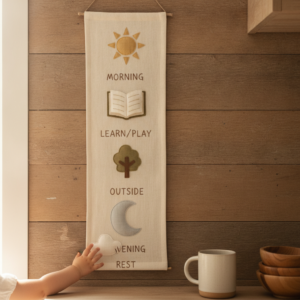
People ask what a typical homeschool day looks like in our house, expecting a color-coded hourly grid. What we actually run on is five blocks, no clock times attached, that flex around whatever the day throws at us.
Block 1: The Anchor
Breakfast together, every day, no screens. This is the one block that never moves regardless of what else happens — it’s the fixed point the rest of the day orients around.
Block 2: Focused Work
Table time — the part of the day that most resembles traditional school. Length varies by age and by day; we watch for attention fading rather than sticking to a set duration.
Block 3: Movement
Outside or active play, regardless of weather — even ten minutes in the backyard counts on a rough-weather day. This block exists because focused work goes noticeably worse without it beforehand.
Block 4: Rest
Quiet time after lunch, non-negotiable for me as much as for the kids. This is the block I resisted longest before admitting the whole day went better once I protected it.
Block 5: Open Afternoon
Whatever’s left over for — errands, projects, free play, catch-up work. This is the block that absorbs the day’s actual chaos, so the earlier four don’t have to.
Why Five, Not More
We tried a more detailed version once, with eight or nine named blocks, and it collapsed within a week from being too fragile. Five simple blocks survive a bad day; nine specific ones don’t.
What This Actually Looks Like on a Real Day
Some days block 2 is twenty minutes; some days it’s an hour. Some days block 5 is three hours of errands and block 3 gets skipped. The order holds even when the lengths don’t, and that’s the entire point.
For the full philosophy behind this, our Building a Homeschool Routine post covers the rest.
If you want a simple way to bring more of this into your week, grab our free guide below.