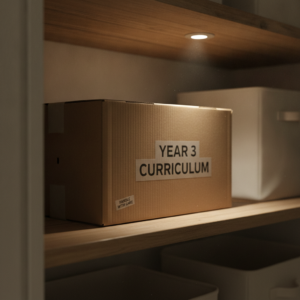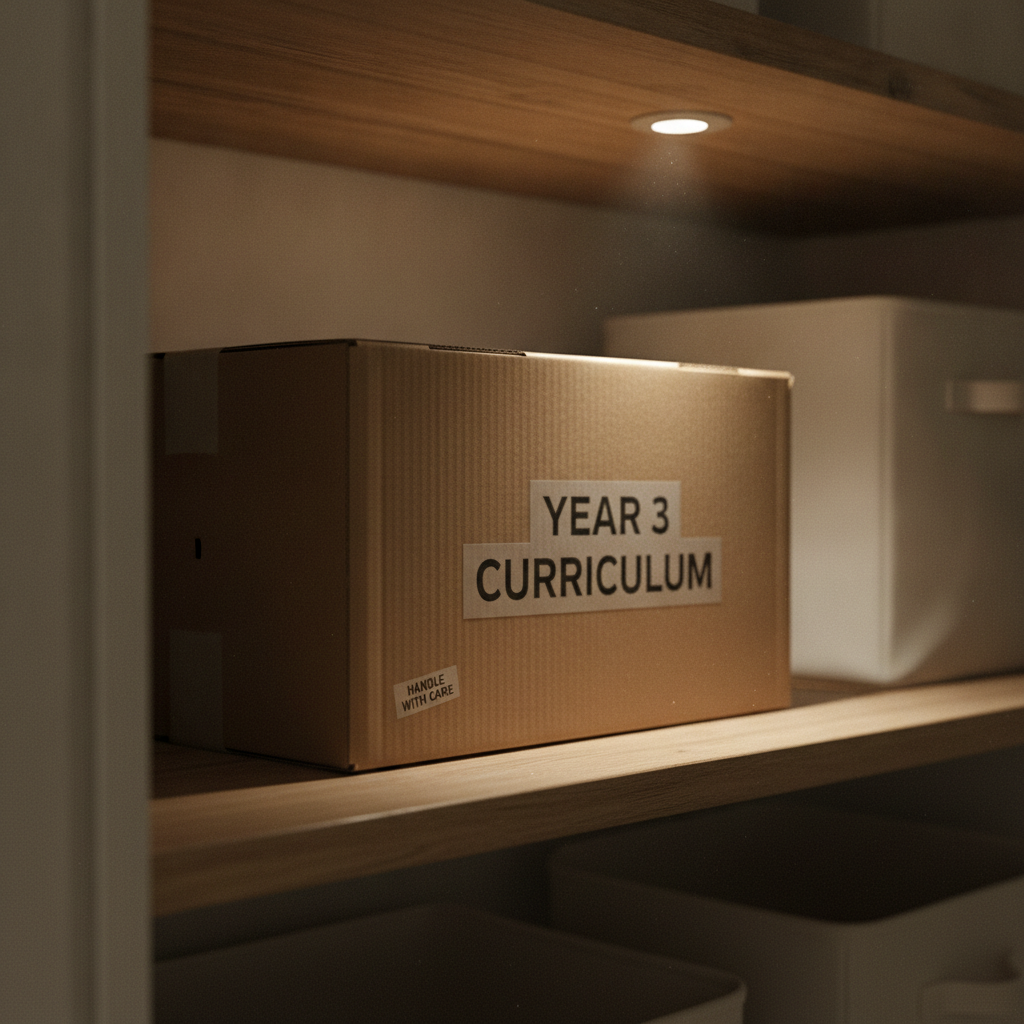
For us, the answer was somewhere around four. A boxed curriculum that was in heavy rotation the first month and down to about a third of its material by month three, still sitting in a closet. A boxed kindergarten program my oldest cried over every morning for six straight weeks before it went in the closet for good. A roughly sixty-dollar science kit that needed supplies we never had on hand. A boxed language arts program that needed forty-five uninterrupted minutes of me a day we simply didn’t have.
The Pattern I Kept Missing
None of these were bad products. Each one just assumed a version of our life we didn’t have – uninterrupted time, supplies on hand, a kid who responds well to that exact format. I bought all four before I ever asked whether that version of our life was real.
What Finally Worked Instead
With phonics, I used about a third of a workbook before switching to just reading together, and it worked better than the workbook ever had. I started choosing playdough and scissors over handwriting drill sheets for the same reason – less resistance, more actual progress. It took several boxes in a closet before I trusted that instinct enough to act on it earlier.
What “Doesn’t Need One” Actually Means
It doesn’t mean no structure. We still use plain workbooks for math because that’s genuinely what works for my oldest. It means the box isn’t automatically the answer just because it’s complete and official-looking. Some of what we own gets used once, some sits unopened a year, and some is still in daily use three years later – the boxes were never the deciding factor.
Figuring that out earlier is exactly what The Intentional Homeschool Planner is meant to help with – a way to test a curriculum decision before it’s box number five.
The rest of what we’ve learned buying and returning curriculum is on our Homeschool hub.