The night before we started homeschooling, I couldn’t sleep. Not because I didn’t have a plan — I had three color-coded binders and a laminated schedule taped inside a cabinet. I couldn’t sleep because somewhere between binder two and binder three, I realized I had no idea what I was actually doing, and in twelve hours, three kids were going to look at me expecting an answer.
If you’re reading this a few days — or a few sleepless nights — before your own start date, I want to tell you what I wish someone had told me: the first 30 days of homeschool were never supposed to look like school. They were supposed to look like figuring each other out.
Why the First 30 Days Aren’t About Curriculum
Every homeschool guide I read before we started focused on curriculum — which math program, which reading series, which science kit to buy first. What none of them mentioned was that the first month isn’t really about content at all. It’s about learning your child’s actual rhythm, not the one you assumed they had.
We didn’t open a single workbook in our first week. Instead, I just watched. When was my middle child actually alert and curious — 9am, or closer to 11? When did my youngest need to move her body before she could sit still for anything? None of that was written in any curriculum guide, and all of it mattered more than the guide did.
That’s the heart of learning that doesn’t only happen at a desk — real homeschooling starts with real observation, not a syllabus.
Week 1 — Just Observe
Resist the urge to “start school” on day one. Spend the first week paying attention instead of teaching:
- Notice which hours your child is naturally curious versus tired or restless.
- Notice what they gravitate toward without being asked — blocks, books, questions about bugs.
- Notice what derails them, so you’re not fighting it later.
I kept a scrap of paper on the fridge that first week, just jotting down times and moods. It felt unproductive at the time. It became the actual blueprint for everything that came after.
Week 2 — Build One Anchor Routine
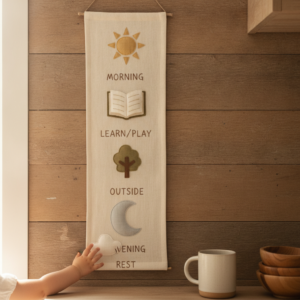
Don’t build a full daily schedule yet. Build one anchor — a single, repeatable moment that happens at roughly the same time every day, that both of you can count on.
Ours was simple: right after breakfast, we read together on the couch for fifteen minutes. That’s it. No math block, no science block yet — just one thing, done consistently, so the day had a shape without being rigid.
One steady anchor does more for a shaky first month than an ambitious six-subject schedule that collapses by Wednesday.
Week 3 — Introduce One Subject at a Time
Now you can start layering in subjects — but one at a time, spaced out, not all at once. This is close to the Montessori idea of “following the child”: instead of deciding in advance exactly what a lesson should look like, you watch what draws your child in, and let that shape how deep you go that day.
In practice, that looked like this for us: simple math games (counting while setting the table) went in first, and a short writing practice only showed up near the end of the week, once reading and math already felt normal.
You don’t need every subject running by week three. You need each new thing to land on solid ground, not scattered on top of chaos.
Week 4 — Reflect and Adjust, Not Perfect
By week four, most new homeschool parents expect to finally have it “figured out.” You won’t, and that’s fine. What week four is actually for is looking honestly at what worked and quietly dropping what didn’t — no guilt required.
We dropped our afternoon “quiet work” block entirely by week four. It looked great on paper and fell apart every single day. Replacing it with twenty extra minutes outside solved a problem no worksheet was going to fix.
Getting it wrong isn’t a sign you’re bad at this. It’s just where you find out what your family actually needs.
Common First-Month Mistakes to Avoid
- Buying a full curriculum before you understand your child’s rhythm.
- Copying someone else’s daily schedule instead of building your own anchor.
- Introducing every subject in the first week “to be safe.”
- Treating one rough day as proof that homeschooling isn’t working.
- Measuring your first month against homeschoolers who are three years in.
Your 30-Day Action Plan
- Week 1: Observe only. No workbooks yet.
- Week 2: Choose one anchor routine and repeat it daily.
- Week 3: Add one subject at a time, following your child’s interest.
- Week 4: Review honestly — keep what worked, drop what didn’t.
- Ongoing: Revisit this same rhythm whenever a new season throws things off again. It’s not just a month-one tool.
For more on the mistakes worth avoiding before you even begin, we’ll be publishing “10 Things Nobody Tells You Before You Start Homeschooling” soon — and if you’re still deciding which approach fits your family, “How to Choose a Homeschool Method Without Losing Your Mind” walks through that decision step by step. You can also browse our full Homeschool hub for more real, tested guides.
If you want a simple way to track your own observations during week one, grab our free guide below — it’s the exact kind of scrap-paper system I wish I’d started with instead of three color-coded binders.