Our first “official” science lesson was a $60 kit with tiny vials and a laminated instruction booklet. It sat untouched for two months. What actually got my kids asking real science questions was baking soda fizzing over the edge of a volcano we built out of a water bottle and some clay from the backyard.
We don’t own a microscope, and we’ve never followed a formal science curriculum. Here’s what’s actually filled that subject slot for us instead.
Questions Come Before Answers
The single biggest shift was resisting the urge to explain everything immediately. When my daughter asked why the ice melted faster in the sun than in the shade, I asked what she thought first, before offering anything myself. Her guesses were usually wrong, and that turned out to matter less than the fact that she’d made one at all.
The Kitchen Is a Better Lab Than a Lab Kit
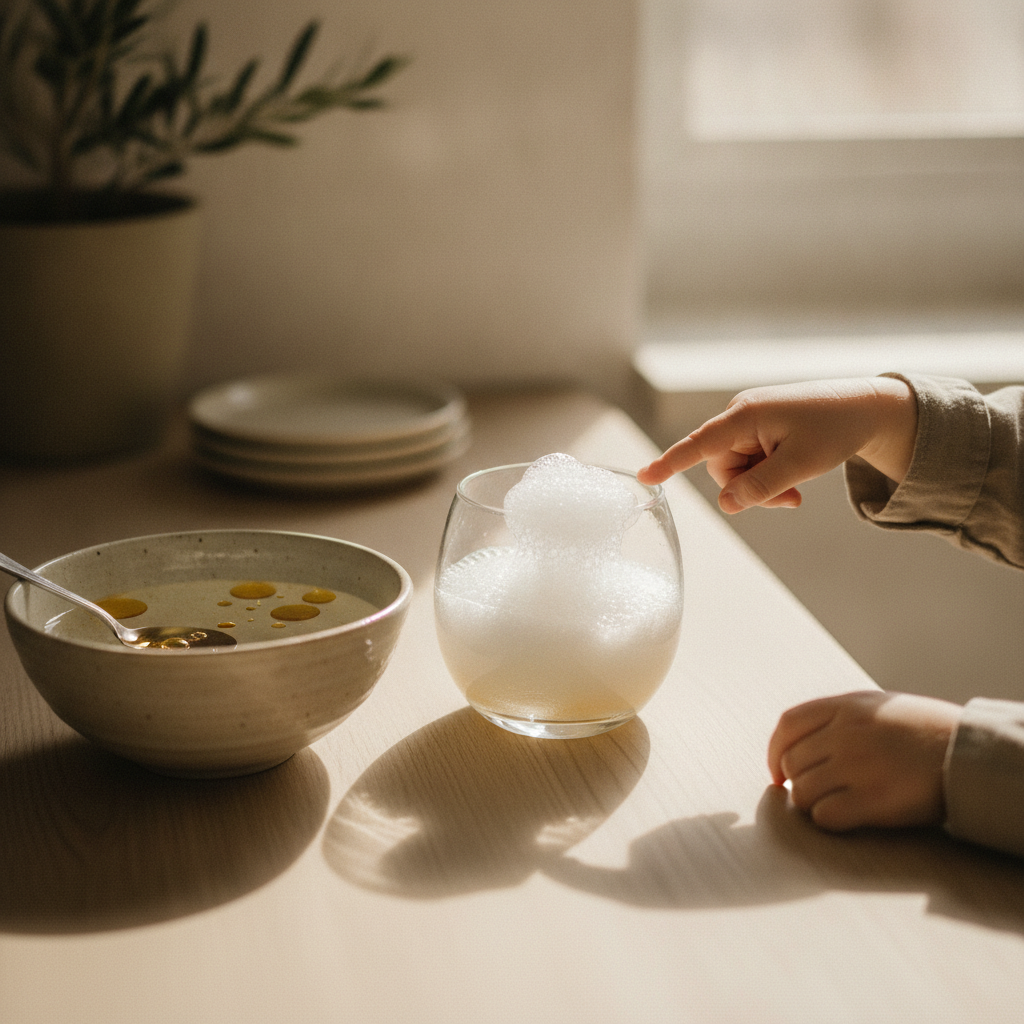
Baking soda and vinegar, oil and water, ice cubes with salt versus without — nearly every “real” experiment we’ve done used things already in the pantry. The $60 kit taught fewer real concepts than a Tuesday afternoon spent seeing which liquids mix and which ones separate.
Predict, Then Test, Every Time
We built one simple habit into every experiment: guess first, out loud, before doing anything. It takes ten extra seconds and it’s the entire scientific method compressed into a single question a five-year-old can answer.
Our Actual Rotation
- Kitchen chemistry: baking soda, vinegar, food coloring, oil and water — a new combination every couple of weeks.
- Backyard biology: watching what happens to a cut piece of fruit over a week, or what lives under a rock.
- Simple physics: ramps, balls, and a stopwatch — which toy rolls farthest, and why.
- Weather noticing: a simple daily glance at the sky and a one-word log of what we saw.
What We Skip
We don’t do worksheets that ask kids to label diagrams of things they’ve never touched. If a concept can’t connect to something we can actually see, smell, or do, we save it for a year or two later when it will.
For more on how we handle other subjects the same hands-on way, our Learning at Home hub has the rest, and Making Math Make Sense covers the same approach for math.
If you want a simple way to bring more of this into your week, grab our free guide below.