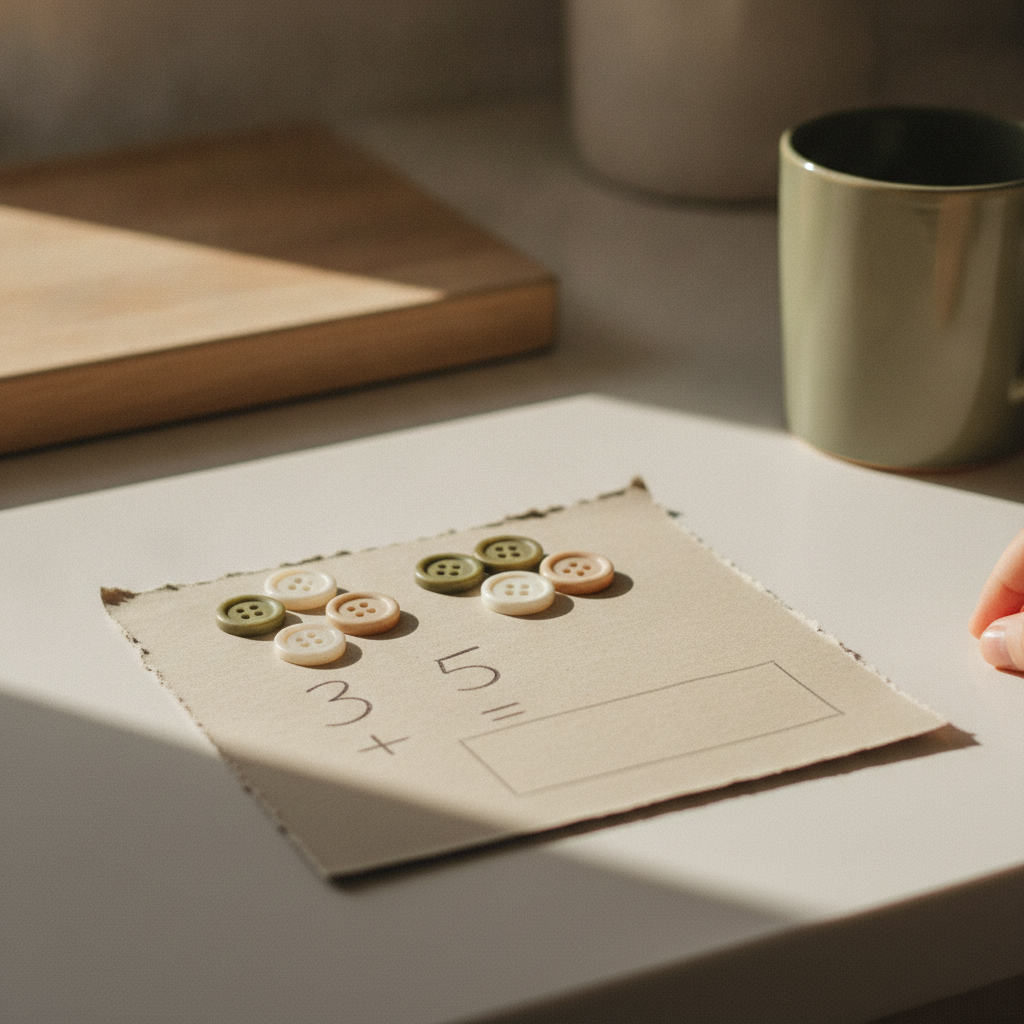
I bought three different math textbooks in our first homeschool year before admitting the problem wasn’t the book. My son could complete a worksheet correctly and still not be able to tell me if six apples split between two people was a fair share. He’d learned to follow steps, not to understand numbers.
Making math make sense without a textbook doesn’t mean skipping math — it means building the number sense first, so the textbook (if you use one at all) actually means something when you get to it. Here’s what that’s looked like at our kitchen table.
We Started With Real Things, Not Symbols
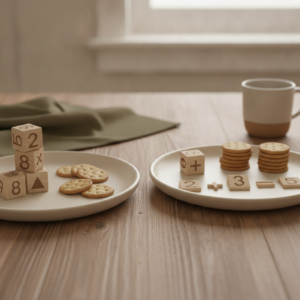
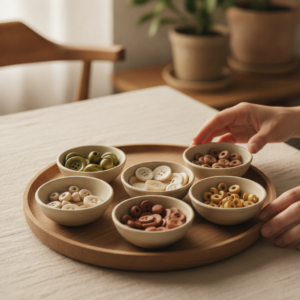
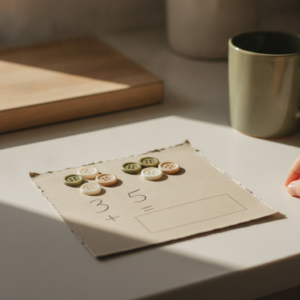
Before “6 + 4 = 10” meant anything, we spent months just moving real objects around — buttons, crackers, coins. Combining two piles and counting the total, splitting one pile into two fair shares. The written symbols came later, as a shorthand for something he already understood with his hands, not as the starting point.
We Talk About Fairness More Than Formulas
“Is that fair?” turned out to be the most powerful math question in our house. Splitting snacks, dividing chores, sharing screen time — every one of these became a real division or fraction problem with actual stakes, which made my kids care about getting the math right in a way a worksheet never achieved.
Estimating Before Calculating
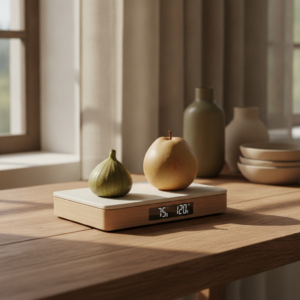
We make a guess before we ever solve anything — how many steps to the mailbox, how many cups of water to fill the pot, how much a stack of books weighs. Being wrong in a guess, then checking the real answer, built a sense for whether a final answer is reasonable that no amount of textbook drilling gave my kids.
Our Actual Weekly Rhythm
- One cooking session a week where measuring does the teaching (see our Cooking as Curriculum post for how this looks in practice).
- Daily “found math” — noticing numbers in real life, out loud, for thirty seconds at most.
- One deliberate game night a week using cards or dice, which does more for mental math than a page of problems.
Where a Textbook Still Earned Its Place
We’re not anti-textbook — we added one back in eventually, for things like standard written procedures (long division, for example) that are genuinely faster to learn from clear written steps. The difference is it came after the number sense was already solid, as a tool, not as the entire subject.
If you’re building this same foundation, our Learning at Home hub has more on how we approach other subjects the same hands-on way.
If you want a simple way to bring more of this into your week, grab our free guide below.