Our first homeschool schedule had math at 9:00, reading at 9:45, and science at 10:30, printed and taped to the fridge. It lasted exactly one day before a diaper blowout, a delivery at the door, and a meltdown over the wrong color cup pushed everything back by two hours and I gave up on it entirely.
A homeschool schedule built on fixed clock times is fighting against how real days actually go. Here’s what we use instead, and why it’s survived far longer than any time-blocked version ever did.
Order Survives. Times Don’t.
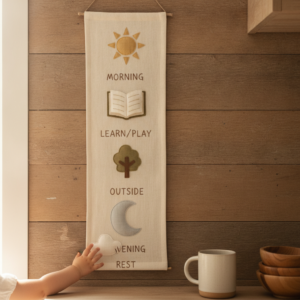
We stopped attaching clock times to anything. Instead, there’s a fixed order — breakfast, then table time, then outside time, then lunch — and it starts whenever the previous thing naturally finishes. A late morning just shifts the whole sequence later; it doesn’t break it.
Build In a Buffer Block on Purpose
Right in the middle of our day sits an unnamed block with nothing assigned to it. Some days it’s extra table time. Some days it’s the only thing that saves the whole schedule when the morning ran long. Having it there, planned, means using it doesn’t feel like falling behind.
Different Days Get Different Shapes
Mondays look different from Fridays in our house, on purpose. Heavier academic work sits earlier in the week when everyone has more energy; Fridays lean toward projects and looser activities. Fighting for identical days all week just meant fighting our own energy patterns.
Our Actual Weekly Shape
- Monday-Wednesday: heavier focused work, mornings.
- Thursday: a lighter academic load, more project time.
- Friday: field trips, catch-up, or a deliberately open day.
- Every day: the same fixed order of blocks, no clock times attached.
What Finally Made This Click
The schedule stopped being something we failed at once we stopped measuring it against a clock. Order gives kids the predictability they actually need; the exact minute something starts almost never matters as much as it feels like it should.
For the daily-rhythm philosophy behind this, our Building a Homeschool Routine post goes deeper, and our Homeschool hub has the rest.
If you want a simple way to bring more of this into your week, grab our free guide below.