A roughly sixty-dollar science kit once sat on a shelf in our house for two months, tiny vials and a laminated booklet untouched, while a baking-soda volcano made from a water bottle and backyard clay got rebuilt three different times because someone kept asking new questions about it. I think about that kit every time I’m tempted to buy another math workbook.
Workbooks and kits both promise a shortcut. In our house, neither one has ever actually been the shortcut.
The Worksheet That Started It
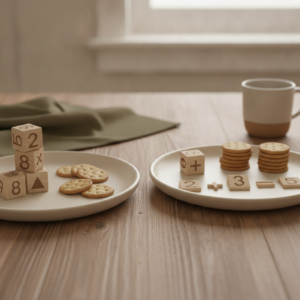
My daughter announced she hated math before finishing a single worksheet. She wasn’t wrong about the worksheet. Once we set it aside and moved math into things she was already doing – sorting, measuring, counting at snack time – the complaints mostly stopped.
Worksheets Can Hide What’s Not There
My son once finished a math worksheet correctly and still couldn’t tell me whether splitting six apples between two people was fair. He’d learned the steps without the understanding underneath them, and the worksheet had no way of showing me that gap. A real apple split in front of him did.
What Replaced Them
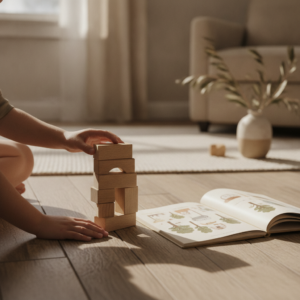
Counting real objects, a shapes walk, sorting socks, snack-time subtraction, measuring steps somewhere – none of it needed a printed page, and all of it asked for more actual thinking than the pages did.
What Still Goes Wrong
I still keep a small stack of workbooks in a drawer for the days I’m out of ideas. I use them less than I used to, but I haven’t thrown them out.
If you want that shift laid out day by day instead of figured out the slow way, 30 Days of Hands-On Kindergarten Math is the version I wish I’d had from the start.
More of what replaced our workbooks is on the Learning at Home hub.