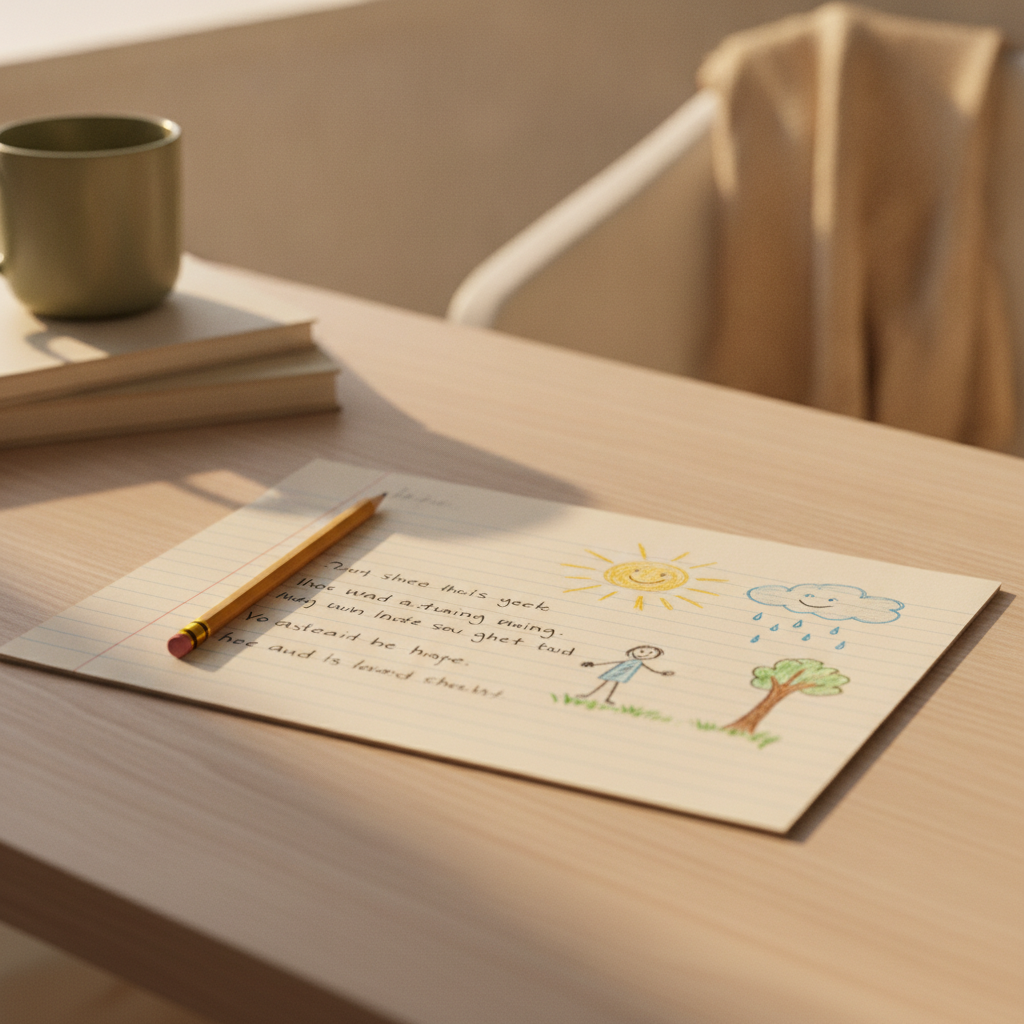
“I don’t know what to write” came out of my son’s mouth roughly every single day for a year, usually followed by tears if I pushed even slightly. Writing was, without question, the subject that broke both of us the most in our early homeschool years.
What finally worked wasn’t a better prompt list. It was separating the two things I’d been quietly bundling together the whole time: having ideas, and physically writing them down.
Talking First, Writing Second
We started every writing session by talking through the idea out loud first, with zero pressure to write anything down yet. Once he’d said the whole story or explanation out loud, the actual writing became transcription of something he already had, instead of invention under pressure with a pencil in his hand.
I Became the Scribe, On Purpose
For months, I wrote down what he dictated while he focused only on the ideas. This felt like “cheating” the first few times I did it. It wasn’t — his handwriting stamina and his storytelling ability were two completely separate skills, and forcing them to develop together was what had been breaking him.
Real Reasons to Write Beat Prompts
A birthday card for grandma. A note left for his sister. A sign for a pretend lemonade stand. These produced more genuine writing than any creative prompt list ever did, because there was an actual person on the other end who was going to read it.
Our Actual Weekly Rhythm
- One short dictated story a week — he talks, I write, he illustrates it after.
- One real-world writing task — a card, a list, a note to someone specific.
- Copywork of a single favorite sentence from a book we’re reading, just to build letter formation without the pressure of composing.
What Changed the Tears Into Something Else
Around age seven, without any announcement, he picked up a pencil and wrote three full sentences on his own, unprompted, about a dream he’d had. I didn’t correct a single spelling mistake. That was the whole point of the years before it.
If writing is a hard subject in your house too, our Learning at Home hub has more on how we approach subjects that don’t come easily, and Raising a Reader at Home covers the reading side of this same struggle.
If you want a simple way to bring more of this into your week, grab our free guide below.