I printed a color-coded homeschool schedule once, laminated it, and taped it to the wall. It lasted four days. Real life — a sick kid, a broken washing machine, a morning nobody could find matching socks — doesn’t care about a schedule with times written in fifteen-minute blocks.
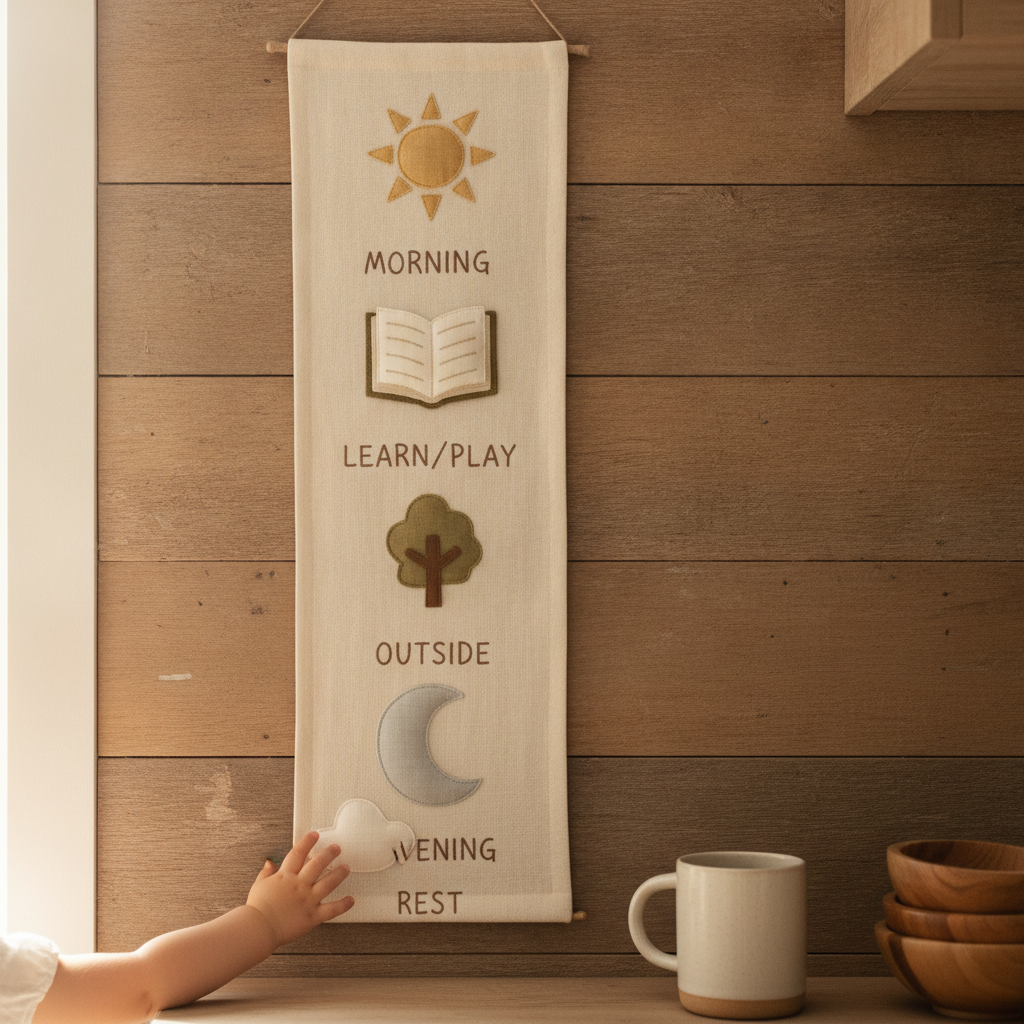
What actually survived, three years later, wasn’t a schedule at all. It was a rhythm — a loose order of blocks that flexes around whatever the day throws at us, instead of a fixed timetable that breaks the first time something goes wrong.
Order, Not Times
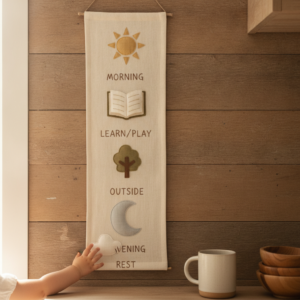
Our routine has no clock times attached to it at all — just a sequence: breakfast, then table time, then outside time, then lunch, then quiet time, then whatever’s left of the afternoon. Whether table time starts at 8:15 or 9:40 doesn’t matter. What matters is that it always comes after breakfast and before outside time, so everyone knows what’s next without needing to check a clock.
The Rhythm Has to Survive a Bad Day
I test every routine change against one question now: will this survive a genuinely bad day? A rigid schedule doesn’t — miss one slot and the whole day feels like a failure. A rhythm just compresses or skips a block and picks back up tomorrow. That single shift in mindset removed more guilt from our homeschool than anything else I changed.
Anchors, Not Every Hour
We only protect two anchors: breakfast and one read-aloud before bed. Everything else can move, shrink, or get skipped on a hard day, but those two stay. Having just two non-negotiables, instead of ten, is what actually made the routine sustainable long-term.
Our Actual 5-Block Rhythm
- Block 1 — Morning anchor: breakfast together, no screens, every day without exception.
- Block 2 — Focused work: table time, the one part of the day that most resembles “school.”
- Block 3 — Movement: outside or active play, regardless of weather, even if it’s just the backyard for ten minutes.
- Block 4 — Rest: quiet time after lunch, non-negotiable for me as much as for the kids.
- Block 5 — Open afternoon: whatever the day has left over for — errands, projects, free play, catch-up.
What I’d Tell Myself Three Years Ago
Stop trying to build a schedule that survives every day perfectly. Build one that survives your worst day, and let the good days take care of themselves.
If your days feel like they need more structure without more rigidity, our Parenting hub has more on the routines and rhythms that hold a homeschool day together.
If you want a simple way to bring more of this into your week, grab our free guide below.
This ties into the Five-Block Rhythm.